
HVAC Considerations When Buying a Home in Kansas City
Last Updated
Kansas City buyers move fast. In a competitive market, it is common to waive contingencies and compress the closing timeline just to win the house. That urgency has a cost, and the heating and cooling system is often where it shows up. HVAC equipment is one of the most expensive components in any home, yet it frequently gets less attention than the roof or the foundation before closing.
Buyers tend to learn what they actually purchased when summer heat or winter cold arrives and the system cannot keep up. Here is what to check, what to ask, and what to negotiate before you sign.
Kansas City buyers move fast. In a competitive market, it is common to waive contingencies and compress the closing timeline just to win the house. That urgency has a cost, and the heating and cooling system is often where it shows up. HVAC equipment is one of the most expensive components in any home, yet it frequently gets less attention than the roof or the foundation before closing.
Buyers tend to learn what they actually purchased when summer heat or winter cold arrives and the system cannot keep up. Here is what to check, what to ask, and what to negotiate before you sign.
Why the HVAC system deserves its own line in your budget
Kansas City homes ask a lot of their heating and cooling equipment. Summers are hot, winters are cold, and both seasons run long enough that a system in marginal condition gets pushed hard. When equipment is undersized, poorly maintained, or simply worn out, it has to run longer to hold temperature. That increases monthly utility costs and shortens the remaining life of the equipment at the same time.
The purchase price of a house is only part of the cost of owning it. A system that is five years from replacement is a real financial fact about the property, and it should be treated the same way you would treat a roof that needs work.
What a standard home inspection actually tells you about HVAC
A general home inspection is valuable, but its HVAC coverage is narrower than most buyers assume. In practice, a standard inspection typically confirms two things: that the furnace produces heat and that the air conditioner produces cool air. That is a basic function check, not an evaluation of remaining lifespan, system sizing, duct condition, or how well the equipment will perform in a Kansas City July.
Inspection reports can flag that an HVAC system appears to be nearing the end of its useful life, along with concerns about the roof or the electrical panel. Those notes are worth reading closely, because they are usually the difference between a system you can live with for years and one that lands on your credit card in the first twelve months.
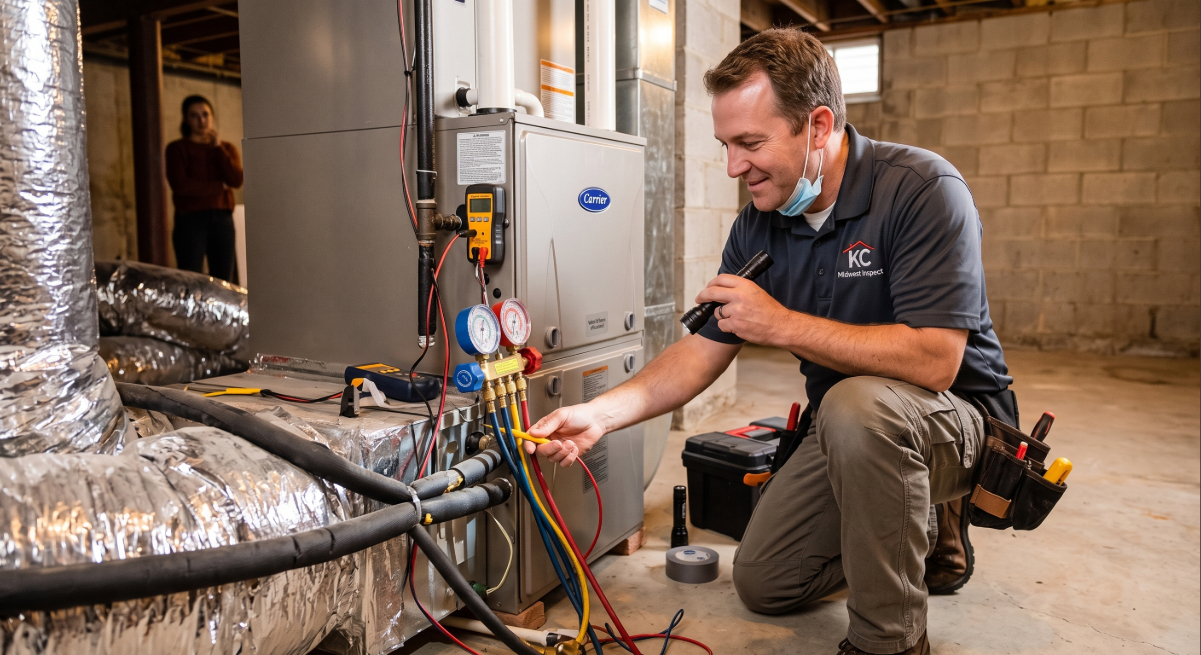
Red flags you can spot during a walkthrough
You do not need tools to notice a system that is struggling. These signs show up in a normal showing, especially if you ask the agent to run the heat or the air conditioning while you are there:
- Rattling or banging noises when the system starts up or shuts down
- Uneven temperatures between upstairs and downstairs rooms
- Higher energy costs than comparable homes of the same size
- Rooms that never seem to reach the temperature shown on the thermostat
- A thermostat that is old, basic, or clearly not controlling the system well
Ask to see recent utility bills if they are available. A seller's average monthly cost through a Kansas City summer and winter tells you more about system performance than a quick glance at the equipment ever will.
Typical Kansas City repair costs to keep in mind
Small failures are not automatically a dealbreaker, but knowing what common repairs run helps you decide whether a problem is a negotiating point or a walk-away issue. Published cost averages for the Kansas City market put several common repairs in these ranges:
Actual quotes vary by company, equipment tier, and the specific system in the house, so treat these as planning figures rather than fixed prices. For comparison, some contractors publish a flat diagnostic fee, such as the $95 diagnostic offered by Luna Heating and Cooling. Either way, a single $300 repair is a very different conversation than a full system replacement, and the inspection should help you figure out which one you are facing.
Questions to ask before you fall in love with the house
Most HVAC problems in a resale home come down to information the seller has and the buyer does not. Ask directly, and ask in writing if you can:
- How old are the furnace and the air conditioner, and where is the manufacture date on the equipment?
- Has the system been serviced annually, and are there records from a licensed contractor?
- Who installed the current equipment, and was it sized for this house?
- Has anything been repaired or replaced in the last few years?
- Are there rooms that have always been hard to heat or cool?
- What type of system is it, and what filtration does it use?
Vague answers are themselves a signal. A seller with a well-maintained system usually has receipts, a filter schedule, and a service company they can name.
New construction and newer homes
Newer builds are not automatically a free pass. Integrating an HVAC system into a new home involves routing ducts, laying pads for exterior AC units, and installing reliable thermostats, and how well those steps were done affects comfort for the life of the house. Older or poorly performing ductwork is a common reason a system has to run longer than it should, which drives up monthly costs and wears equipment faster.
If you are buying new construction, ask about the equipment warranty and whether it transfers to you as the second owner. Confirm who handles warranty service, and get the model numbers of the furnace, condenser, and thermostat in writing before closing.
Packaged units and other system types
Not every Kansas City home uses the same equipment layout. Packaged HVAC units, which combine heating and cooling in a single outdoor cabinet, are described by area contractors as a cost-effective, efficient, and low-maintenance option for many local homes. Other properties use a more traditional split system with an indoor furnace or air handler and an outdoor condenser.
Know which one you are buying. It affects replacement cost, where service work happens, and how much space the equipment needs. If a listing does not make the system type clear, ask before the inspection period ends.
What to negotiate before closing
In a competitive Kansas City market, buyers routinely waive contingencies and accelerate closing timelines to secure a property. That is exactly the environment where HVAC problems slip through, and it is why an HVAC-specific evaluation during your inspection window is worth the scheduling effort.
Once you have real information, you have options. You can ask the seller to complete a specific repair, request a credit at closing toward replacement or near-term repairs, or simply adjust your offer to reflect the condition. If the inspection finds equipment nearing the end of its useful life, that finding is the basis for the conversation. Get repair estimates in writing before you negotiate so the number you ask for is grounded in an actual quote, not a guess.
After closing: maintenance, warranties, and who to call
Budget for maintenance from day one. Annual service on the furnace and air conditioner is the cheapest way to protect the equipment you just paid for, and regular filter changes keep the system from working harder than it needs to. If the inspection notes uneven temperatures between floors, ask a technician to look at airflow and duct balance rather than assuming you need new equipment.
When replacement does become necessary, pricing and financing matter as much as the equipment. Luna Heating and Cooling, a Kansas City-area contractor serving communities including Overland Park, Leawood, Shawnee, and Liberty, offers a $95 diagnostic, 10-year warranties, and next-day availability, along with 0% APR financing options and system packages that bundle equipment with smart thermostats. Comparing a few quotes on the same job is smart, because homeowner reports in the Kansas City area show quotes varying by thousands of dollars for what sounds like identical work.
An HVAC system is not a small detail in a home purchase. Spend an hour on it before closing, and you will spend a lot fewer hours and dollars on it afterward.
Frequently Asked Questions
Does a standard home inspection check the HVAC system?
Yes, but only at a basic level. A standard inspection typically confirms that the furnace produces heat and the air conditioner produces cool air. It generally does not evaluate remaining lifespan, system sizing, or duct performance. If you want a real picture of the equipment's condition, schedule a separate HVAC evaluation during your inspection period with a licensed technician.
How old is too old for a furnace or air conditioner in Kansas City?
There is no universal cutoff, because condition and maintenance history matter as much as age. Instead of chasing a specific number, ask for the manufacture date and service records, then have a technician assess the equipment. If the system is nearing the end of its useful life, use that finding to negotiate a repair, a credit, or a price adjustment before closing.
Should I ask the seller to replace the HVAC system before closing?
You can ask, but a closing credit is often more practical than a rushed replacement. A seller choosing equipment on a deadline may select the cheapest option available. A credit lets you choose the contractor, the equipment tier, and the timing, and it pairs well with financing options if the new system costs more than the credit covers.
How much does HVAC repair cost in Kansas City?
Published Kansas City averages put diagnostic fees between $70 and $140, AC capacitor replacement between $190 and $375, and AC contactor replacement between $190 and $425. Actual quotes vary by company and system, so collect written estimates before negotiating. Some contractors publish flat diagnostic pricing, such as the $95 diagnostic offered by Luna Heating and Cooling.
What should I check in a new construction home?
Ask how the ducts were routed, where the exterior AC pads were set, and what thermostat was installed. Confirm the equipment warranty and whether it transfers to you. Get model numbers for the furnace, condenser, and thermostat in writing, and identify which company handles warranty service so you are not starting from scratch if something fails in the first year.
